
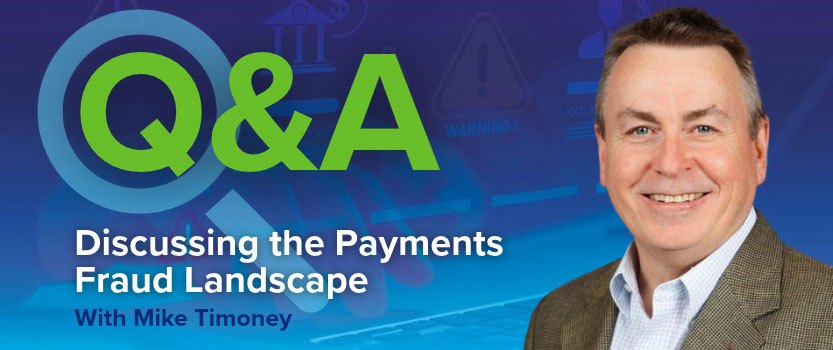


Mike Timoney is the vice president of payments system improvement for Federal Reserve Financial Services (FRFS). In this interview, Timoney shares his insights into the current payments fraud landscape and how FRFS is partnering with the payments industry to combat fraud.
What was your journey to becoming a fraud fighter and to the Federal Reserve?
My career started in banking, where I focused on international payments and risk management. Working in payments gave me a front-row seat to the complexity of the ecosystem and the constant challenges posed by fraud. When the opportunity came to take on payment fraud responsibilities, I jumped at it. That role ignited my passion for fraud prevention and reinforced the importance of collaboration and education in fighting financial crime.
In 2019, I retired from banking and joined the Federal Reserve. Now, as vice president of payments system improvement for FRFS, I lead a team committed to strengthening the security, efficiency and accessibility of the U.S. payment system. My banking background helps me connect with industry participants, and through ongoing engagement with stakeholders, I work to protect financial institutions and businesses from evolving threats and support the broader mission of safeguarding the payments ecosystem.
What changes or trends are you seeing in the industry that are shaping the fraud landscape?
Fraud is evolving fast, and several trends are reshaping the landscape. Some developments our team is closely following include:
- Life-cycle-level fraud. Fraud isn’t just a single threat anymore; it’s a portfolio of risks that span the entire payment life cycle.
- Automation and AI. Criminals are using new tools to scale attacks, deploy deepfakes and exploit vulnerabilities across channels.
- Social engineering and impersonation: Attackers are getting more sophisticated, using personalized messages, deepfake voice/video and scripted attacks to manipulate victims and erode trust.
- Account takeover fraud and synthetic identity fraud: Credential stuffing, session hijacking and synthetic identities are fueling new forms of fraud, exploiting weak authentication and legacy systems.
These trends underscore the need for prevention, collaboration and adaptability. Fraud is modernizing quickly, and all of our defenses must keep pace.
How is the Federal Reserve helping combat payment fraud in the ecosystem?
FRFS supports fraud mitigation by providing practical tools and resources, fostering industry collaboration and advancing education. We offer specialized toolkits to help financial institutions and partners strengthen their defenses against account takeover fraud, check fraud, scams and synthetic identity fraud. Our risk mitigation tools for ACH, check and instant payments give organizations targeted resources to help identify and address vulnerabilities across these channels.
We regularly connect with the industry through webinars, speaking engagements, customer advisory groups and collaborative initiatives. These forums are a chance for us to share best practices and emerging trends, listen to customers’ pain points, and keep organizations informed and prepared for new threats.
Our ongoing commitment to education, development of new services and industry partnership helps advance fraud mitigation across the payments ecosystem. The goal is to equip organizations with the knowledge and tools they need to proactively address risks and adapt to new challenges as they arise.
What’s a common myth about payment fraud you’d like to debunk?
A common myth I hear is that payment fraud is only about unauthorized transactions — someone hacking into an account and moving money without approval. The reality is, a large share of payment fraud involves authorized transactions, where the account holder is manipulated or deceived into sending funds. Scams, social engineering and impersonation tactics are getting more sophisticated, and criminals often exploit trust and urgency to get people to act against their own interests.
Another misconception is that fraud is limited to a single payment type or channel. Criminals adapt quickly, targeting checks, wires, ACH and digital payments alike. The landscape is constantly shifting, and no single product or channel is immune.
Payment fraud is a portfolio of risks that spans the entire life cycle, from onboarding and authentication to payment initiation and servicing. It’s not just a technical problem; it’s a human one. Awareness, education and collaboration across the industry are essential to staying ahead.
What is the number one piece of advice you have for organizations to put into action today regarding fraud?
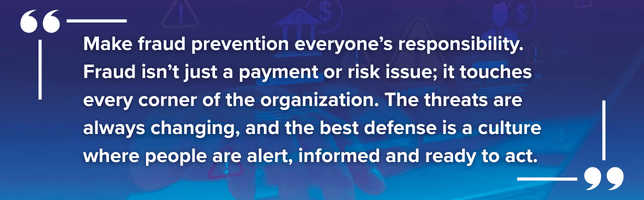
If I had to give one piece of advice, it would be this: Make fraud prevention everyone’s responsibility. Fraud isn’t just a payment or risk issue; it touches every corner of the organization. The threats are always changing, and the best defense is a culture where people are alert, informed and ready to act.
That means investing in ongoing education, encouraging open conversations about fraud risks, and regularly reviewing your controls and processes. Collaboration, both within your organization and with industry partners, is essential. When we share information and learn from each other, we’re better positioned to spot new threats and respond quickly.
Fraud prevention works best when it’s woven into the fabric of the organization, not treated as a one-off project or a box to check.