
Skip to Content

The Federal Reserve - FRBservices.org
  • Application Sign In
    • Discount Window Direct
    • FedLine Developer
    • FedLine Web
    • Reporting Central
    • Reserves Central
    • Structure Central
    • Survey Central
    • Term Deposit Facility
  • Service Status
  • Contact
  • Financial Services
    • Accounting
      • Accounting Information Services (AIS) – Premium Services
      • Account Management Information
      • Daily Statement of Account
      • Daylight Overdraft Reports
      • Statement of Service Charges

      • Accounting Services 2026 Fee Schedulle
      • Account Services Business Continuity Guide
      • Accounting Services Forms
      • Accounting Services Resources
      • Accounting Services Setup
    • Check Services
      • Check Adjustments Services
      • Duplicate Check Notification
      • Electronic Check Processing
      • FedImage and Electronic Check Services
      • FedPayments Reporter Service for Check Services
      • Foreign and Canadian Check Service
      • Image-Enabled Savings Bond Processing
      • Paper Check Clearing Services

      • Check Services 2026 Fee Schedule
      • Check Services Forms
      • Check Services Resources
      • Check Services Setup
      • Check Services Testing Opportunities
    • FedACH Services
      • Exception Resolution Service
      • FedACH Information File Service
      • FedACH Origination and Receipt
      • FedACH Receipt Discount Program
      • FedACH Risk Management Services
      • FedACH SameDay Service
      • FedGlobal ACH Payments
      • FedPayments Insights Service
      • FedPayments Reporter Service for FedACH Services

      • FedACH Services 2026 Fee Schedule
      • FedACH Services Business Continuity Guide
      • FedACH Services Forms
      • FedACH Services Resources
      • FedACH Services Setup
      • FedACH Services Testing Opportunities
    • FedCash Services
      • Cash Visibility
      • Coin
      • Coin Terminal Services
      • Currency
      • FedCash Services via the FedLine Web Solution

      • FedCash Services 2026 Fee Schedule
      • FedCash Services Business Continuity Guide
      • FedCash Services Forms
      • FedCash Services Resources
      • FedCash Services Setup
    • FedNow Service
      • About the FedNow Service
      • Blog Articles (Off-site)
      • FedNow Explorer (Off-site)
      • FedNow Service Participants and Service Providers
      • Industry Stories
      • Instant Payments Education (Off-site)
      • Innovator Exchange
      • Participant Collaboration

      • FedNow Service 2026 Fee Schedule
      • FedNow Service Forms
      • FedNow Service Resources
    • Fedwire Funds Service
      • FedTransaction Analyzer

      • Fedwire Funds Service 2026 Fee Schedules
      • Fedwire Funds Service Business Continuity Guide
      • Fedwire Funds Service Forms
      • Fedwire Funds Service Resources
      • Fedwire Funds Service Setup
      • Fedwire Services Testing Opportunities
    • Fedwire Securities Service
      • Fedwire Securities Joint Custody Service

      • Fedwire Securities Resources
      • Fedwire Securities Service 2026 Fee Schedules
      • Fedwire Securities Service Business Continuity Guide
      • Fedwire Securities Service Forms
      • Fedwire Securities Service Setup
      • Fedwire Services Testing Opportunities
    • Multiservice Solutions
      • Payee Name Verification

      • Multiservice Solutions 2026 Fee Schedules
    • National Settlement Service
      • National Settlement Service 2026 Fee Schedule
      • National Settlement Service Business Continuity Guide
      • National Settlement Service Forms
      • National Settlement Service Resources
      • National Settlement Service Setup
  • Central Bank
    • Lending Central (Discount Window)
      • Discount Window Direct (DWD) Early Adopter Program Expression of Interest Form
      • Discount Window Direct (DWD) Feature Guide

      • Central Bank Forms
      • Central Bank Resources
      • Discount Window Direct (DWD) Application Setup
    • Reporting Central
      • Reporting Central and Structure Central User Guides

      • Central Bank Forms
      • Reporting Central and Structure Central Applications Setup
      • Reporting Central National Business Continuity Information
      • Reporting Central Resources
    • Reserves Central
      • Excess Balance Account
      • Schedule for Maintenance Periods and Interest Payments on Reserve Balances
      • Term Deposit Facility

      • Central Bank Forms
      • Central Bank Resources
      • Reserves Administration Business Continuity Guide
      • Reserves Central Service Setup
  • Treasury Services
    • Collateral Services
    • Savings Bonds for Financial Institutions
    • Savings Bonds News You Can Use
    • Treasury ACH Reclamation
    • Treasury Auctions
    • Treasury Check Reclamation

    • Treasury Services Business Continuity Guide
    • Treasury Service Forms
    • Treasury Services Resources
    • Treasury Services Setup
  • FedLine Solutions
    • FedLine Advantage
    • FedLine Command
    • FedLine Developer
    • FedLine Direct
    • FedLine Web
    • FedMail

    • Application and Connectivity Testing
    • FedLine Solutions 2026 Fee Schedules
    • FedLine Solutions Business Continuity Guide
    • FedLine Solutions Forms
    • FedLine Solutions Resources
    • FedLine Solutions Setup
  • Forms
    • Accounting Services Forms
    • Central Bank Forms
    • Check Services Forms
    • FedACH Services Forms
    • FedCash Services Forms
    • FedLine Solutions Forms
    • FedNow Service Forms
    • Fedwire Funds Service Forms
    • Fedwire Securities Service Forms
    • National Settlement Service Forms
    • Treasury Services Forms

    • Forms Frequently Asked Questions
  • Resources
    • Central Bank Resources
      • Central Bank Frequently Asked Questions
      • Reporting Central Resources
      • Structure Central Resources
      • Survey Central Resources
    • E-Payments Routing Directory
    • FedLine Solutions Resources
      • End User Authorization Contact Support Page for FedLine EUACs
      • FedLine Command Environment and Configuration Change Matrix
      • FedLine Direct File Environment and Configuration Change Matrix
      • FedLine Direct Message Environment and Configuration Change Matrix
      • FedLine Solutions Frequently Asked Questions
    • Financial Services Resources
      • Accounting Services Resources
      • Check Services Resources
      • FedACH Services Resources
      • FedCash Services Resources
      • FedGlobal ACH Payments Foreign Exchange Rates
      • FedNow Service Resources
      • Fedwire Funds Service Resources
      • Fedwire Securities Resources
      • National Settlement Service Resources
    • Industry Links
    • Resource Centers
      • Business Continuity Resource Center
      • FedLine Solutions Security and Resiliency Assurance Program (“Assurance Program”) Resource Center
      • International Payments Resource Center
      • Same Day ACH Resource Center
      • Welcome to the Business Banking Toolbox!
      • Welcome to the Risk Management Toolbox!
    • Rules and Regulations
      • Operating Circulars
      • Regulations
    • Service and Access Setup
      • Current Financial Services Customer – Add or Modify Services or Access
      • Financial Institution Merger – Modify Services or Access
      • New Financial Services Customer – Setup Services or Access
      • Payment Processors and Third-Party Service Providers – Set Up Services and Access
    • Service Fees
    • Treasury Services Resources
      • Collateral Services
      • Savings Bonds for Financial Institutions
      • Treasury Auctions
      • Treasury Services Frequently Asked Questions
  • Education
    • Federal Reserve Bank Webinars
    • Industry Events
    • Products & Services Education
  • News
    • Communications
    • Fed360
    • Press Releases
    • Research
    • Stay Engaged: Email Newsletters
  • About
    • About Federal Reserve Bank Services
    • Advisory Groups
    • Federal Reserve Bank Offices
    • Financial Services Leadership Team
    • Holiday Schedules
Home/News/Fed360/From simple scams to sophisticated multichannel attacks: The evolution of phishing, spoofing and impersonation
Fed360 logo
  • Fed360 Home
  • Dates to Remember
  • In Case You Missed It
    • How teens and young adults are victimized: Understanding scam risk across customer segments
  • In This Issue
    • Conference Connection: Advancing payment innovation at fall 2026 events
    • U.S. Currency Program now producing nonsequential $1, $2, $5, $20 straps
    • New educational resources in Account Takeover Fraud Mitigation Toolkit
    • FedNow discount program: Accelerating the next wave of instant payment adoption
    • Streamline your ACH operations: A guide to FedACH APIs
  • Article Archives
  • Stay Engaged: Email Newsletters
  • Email the Editor
Join the largest instant payments network in the U.S. Learn More. The Federal Reserve Financial Services. FedNow Instant Payments.
laptop screen warning icons phishing and scam emails

From simple scams to sophisticated multichannel attacks: The evolution of phishing, spoofing and impersonation

Fraud Mitigation

|

June 2, 2026

|

X

Phishing is a fraudulent attempt to obtain sensitive information by impersonating a trusted source through deceptive messaging. It has been a persistent threat to financial institutions for decades, but the nature of these attacks has changed dramatically. What once consisted of awkward emails with obvious grammatical errors has evolved into highly coordinated, multichannel schemes involving spoofed phone numbers and email addresses, impersonation of trusted people, and more effective social engineering. For financial institutions and their customers, this evolution significantly increases the danger of this threat.
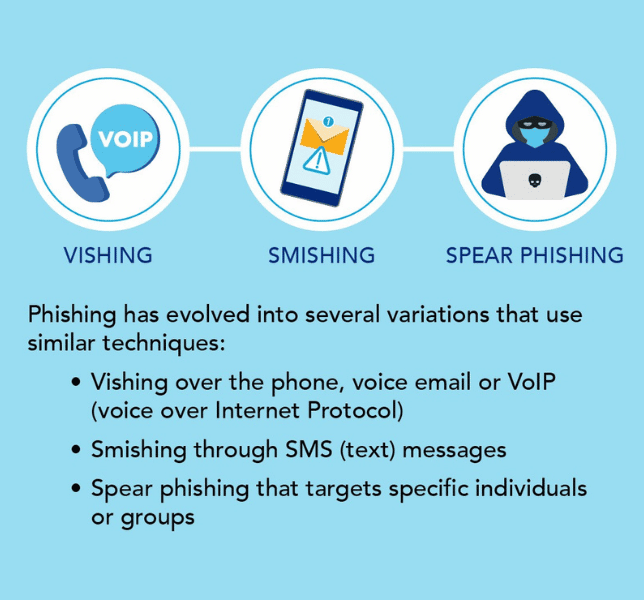
phishing has evolved into several variations with similar techniques: vishing, smishing, spear phishing

Vishing, Smishing, Spear Phishing Phishing has evolved into several variations that use similar techniques: Vishing over the phone, voice email or VoIP (voice over Internet Protocol); Smishing through SMS (text) messages; Spear phishing that targets specific individuals or groups

The early days: Simple, single channel attacks

In the early years of email, phishing typically was easier to identify. Criminals relied on sending generic mass emails that often had poor grammar and used suspicious-looking email addresses. The malicious request often involved opening an attachment or clicking a link that would install malware or ask for personally identifiable information or account credentials.

Example of a Traditional “Old-School” Attempt:
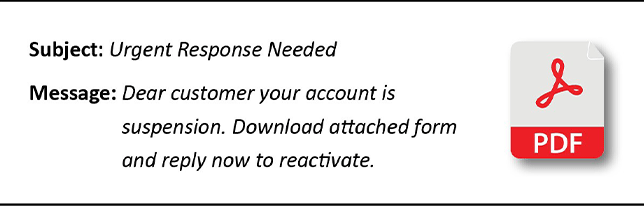
traditional "old-school" attempt at phishing with attachment leading to malware installation

Malicious email request with the subject line: Urgent Response Needed. The message reads: Dear customer your account is suspension. Download attached form and reply now to reactivate.

The modern threat: Multichannel, refined and personal
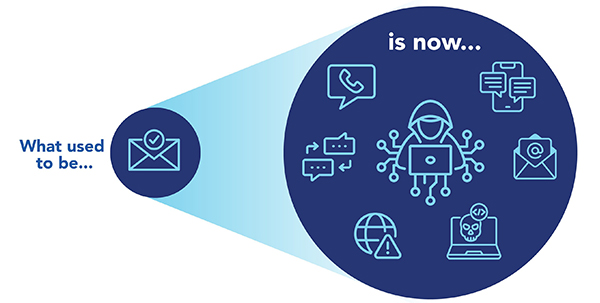
what used to be a simple scam email is now a sophisticated cross-channel coordinated operation

A visual graphic depicting a small icon of a sent email that expands to a spotlight depicting an ecosystem of channels across which criminals create believable and persistent fraud campaigns.

Most phishing campaigns now look nothing like these previous rudimentary attempts. Criminals may operate with the sophistication of professional organizations by blending technology, psychology and cross-channel coordination to create believable and persistent fraud attempts.

Characteristics of this modern threat may include:

  • Emails, phone calls and text messages that appear to come from legitimate entities
  • Spoofed phone numbers used to follow up with “verification” calls
  • Text messages mimicking alerts or two-factor authentication requests
  • Simultaneous social engineering to pressure victims into acting
  • Ability to translate messages into most global languages
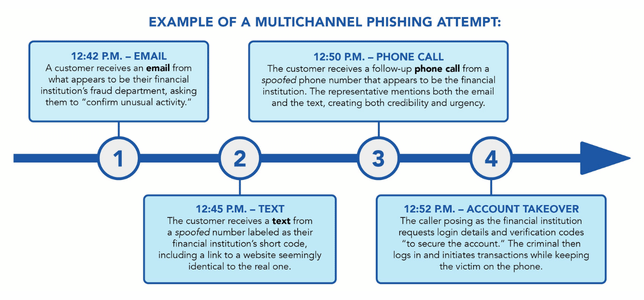
example of multichannel phishing attempt across email, text, phone call and account takeover

A flow chart depicting an example of a multichannel phishing attempt. Step 1 begins over email at 12:42 p.m. A customer receives an email from what appears to be their financial institution’s fraud department, asking them to ‘confirm unusual activity.’ Step 2 is at 12:42 p.m. over text. The customer receives a text from a spoofed number labeled as their financial institution’s short code, including a link to a website seemingly identical to the real one. Step 3 is a phone call at 12:50 p.m. The customer receives a follow-up phone call from a spoofed phone number that appears to be the financial institution. The representative mentions both the email and the text, creating both credibility and urgency. The final step occurs at 12:52 p.m. with an account takeover. The caller posing as the financial institution requests login details and verification codes ‘to secure the account.’ The criminal then logs in and initiates transactions while keeping the victim on the phone.

This multichannel approach can reduce the victim’s suspicions and drastically increase account takeover success rates. It also may bypass traditional controls, since communication is happening across multiple channels.

How financial institutions can protect themselves and their customers

These attempts typically succeed when criminals can impersonate an institution or other trusted entity, convince the victim and move money before detection. Effective mitigation requires proactive education and layered defenses across all three stages.

Prevent

Stop criminals from successfully impersonating the institution.

DefensesChannelWhy This MattersExamples
Sender identity verificationEmailPrevents criminals from sending emails that appear to come from the financial institution’s domainEmail authentication methods:
  • SPF (sender policy framework)
  • DKIM (DomainKeys identified mail)
  • DMARC (domain-based message authentication, reporting and conformance)
Caller identity verificationPhoneReduces the effectiveness of caller ID spoofing used in impersonation scamsStir/shaken: Secure telephone identity revisited and signature-based handling of asserted information using tokens
Brand and domain protectionEmail/webIdentifies fraudulent domains or websites impersonating the financial institution early when large campaigns launch
  • Domain impersonation monitoring
  • Phishing site takedowns

Verify

Help customers or employees confirm whether a communication is legitimate.

CapabilityChannelWhy This MattersExamples
Customer scam awarenessAll customer communication channelsCustomers who recognize scam tactics may be less likely to engage with criminals
  • Scam tactic education
  • Timely scam alerts
Secure customer communication channelsOnline banking/mobile Provides a trusted place for customers to verify message claiming to be from the financial institution
  • Secure message portal
  • Authenticated chat
Out-of-band verification proceduresPhone/emailConfirms high-risk requests using a secondary, trusted communication method
  • Call-back verification
  • Known contact validation

Disrupt

Stop or identify the fraud before money leaves the account.

CapabilityChannelWhy This MattersExamples
Transaction verification controlsDigital banking/phonePrevents criminals from completing high-risk payment requestsDual authorization and payment confirmation
Suspicious activity monitoringDigital bankingDetects unusual behavior associated with scams or account takeoverBehavioral monitoring tools (e.g., tools that establish a baseline for customers and identify irregular patterns)
Customer transaction alertsSMS/email/appEnables customers to quickly identify and report unauthorized activityReal-time alerts and push notifications

Phishing has progressed from simple scam attempts via email into coordinated, high-pressure, multichannel attempts that exploit trust, timing and technology. As criminals continue using advanced impersonation and spoofing tactics, defenses must grow equally dynamic.

Proactive education and layered defenses, such as multichannel verification and prompt response capabilities, are critical. By strengthening these areas, financial institutions can protect both themselves and their customers from increasingly complex phishing attempts.

Related Content

  • Considerations for Financial Institutions to Detect Scams (PDF, Off-site)
  • Scam Detection and Mitigation for Financial Institutions (PDF, Off-site)
  • Harnessing the power of ISO® 20022: Why the global payment standard matters for fraud mitigation

Current Issue

previous arrow
Conference Connection: Advancing payment innovation at fall 2026 events

Education and Resources

Conference Connection: Advancing payment innovation at fall 2026 events
U.S. Currency Program now producing nonsequential $1, $2, $5, $20 straps

Cash

U.S. Currency Program now producing nonsequential $1, $2, $5, $20 straps
New educational resources in Account Takeover Fraud Mitigation Toolkit

Risk Management

New educational resources in Account Takeover Fraud Mitigation Toolkit
FedNow® discount program: Accelerating the next wave of instant payment adoption

FedNow Service

FedNow® discount program: Accelerating the next wave of instant payment adoption
Streamline your ACH operations: A guide to FedACH® APIs

FedLine Solutions

Streamline your ACH operations: A guide to FedACH® APIs
next arrow
  • X
  • LinkedIn

FINANCIAL SERVICES

  • Accounting
  • Check Services
  • FedACH Services
  • FedCash Services
  • FedNow Service
  • Fedwire Funds Service
  • Fedwire Securities Service
  • Multiservice Solutions
  • National Settlement Service

CENTRAL BANK

  • Lending Central (Discount Window)
  • Reporting Central
  • Reserves Central

TREASURY SERVICES

  • Collateral Services
  • Savings Bonds for Financial Institutions
  • Savings Bonds News You Can Use
  • Treasury ACH Reclamation
  • Treasury Auctions
  • Treasury Check Reclamation

FEDLINE® SOLUTIONS

  • FedLine Advantage
  • FedLine Command
  • FedLine Developer
  • FedLine Direct
  • FedLine Web
  • FedMail

FORMS

  • Accounting Services Forms
  • Central Bank Forms
  • Check Services Forms
  • FedACH Services Forms
  • FedCash Services Forms
  • FedLine Solutions Forms
  • Fedwire Funds Service Forms
  • Fedwire Securities Service Forms
  • National Settlement Service Forms
  • Treasury Services Forms

RESOURCES

  • Central Bank Resources
  • E-Payments Routing Directory
  • FedLine Solutions Resources
  • Financial Services Resources
  • Industry Links
  • Resource Centers
  • Rules and Regulations
  • Service and Access Setup
  • Service Fees
  • Treasury Services Resources

EDUCATION

  • Federal Reserve Bank Webinars
  • Industry Events
  • Products & Services Education

NEWS

  • Communications
  • Fed360
  • Press Releases
  • Research
  • Stay Engaged: Email Newsletters

ABOUT

  • About Federal Reserve Bank Services
  • Advisory Groups
  • Federal Reserve Bank Offices
  • Financial Services Leadership Team
  • Holiday Schedules

CONTACT

SITEMAP


This site is a product of the Federal Reserve Banks.
Terms of Use | Supported Browsers | Privacy Policy
General Reserve Bank Data Privacy Notice | Reprinting Articles

Address comments and questions to the
FRBservices.org Web Master
© 2026 Federal Reserve Banks