


Skip to Content

The Federal Reserve - FRBservices.org
  • Application Sign In
    • Discount Window Direct
    • FedLine Developer
    • FedLine Web
    • Reporting Central
    • Reserves Central
    • Structure Central
    • Survey Central
    • Term Deposit Facility
  • Service Status
  • Contact
  • Financial Services
    • Accounting
      • Accounting Information Services (AIS) – Premium Services
      • Account Management Information
      • Daily Statement of Account
      • Daylight Overdraft Reports
      • Statement of Service Charges

      • Accounting Services 2026 Fee Schedulle
      • Account Services Business Continuity Guide
      • Accounting Services Forms
      • Accounting Services Resources
      • Accounting Services Setup
    • Check Services
      • Check Adjustments Services
      • Duplicate Check Notification
      • Electronic Check Processing
      • FedImage and Electronic Check Services
      • FedPayments Reporter Service for Check Services
      • Foreign and Canadian Check Service
      • Image-Enabled Savings Bond Processing
      • Paper Check Clearing Services

      • Check Services 2026 Fee Schedule
      • Check Services Forms
      • Check Services Resources
      • Check Services Setup
      • Check Services Testing Opportunities
    • FedACH Services
      • Exception Resolution Service
      • FedACH Information File Service
      • FedACH Origination and Receipt
      • FedACH Receipt Discount Program
      • FedACH Risk Management Services
      • FedACH SameDay Service
      • FedGlobal ACH Payments
      • FedPayments Insights Service
      • FedPayments Reporter Service for FedACH Services

      • FedACH Services 2026 Fee Schedule
      • FedACH Services Business Continuity Guide
      • FedACH Services Forms
      • FedACH Services Resources
      • FedACH Services Setup
      • FedACH Services Testing Opportunities
    • FedCash Services
      • Cash Visibility
      • Coin
      • Coin Terminal Services
      • Currency
      • FedCash Services via the FedLine Web Solution

      • FedCash Services 2026 Fee Schedule
      • FedCash Services Business Continuity Guide
      • FedCash Services Forms
      • FedCash Services Resources
      • FedCash Services Setup
    • FedNow Service
      • About the FedNow Service
      • Blog Articles (Off-site)
      • FedNow Explorer (Off-site)
      • FedNow Service Participants and Service Providers
      • Industry Stories
      • Instant Payments Education (Off-site)
      • Innovator Exchange
      • Participant Collaboration

      • FedNow Service 2026 Fee Schedule
      • FedNow Service Forms
      • FedNow Service Resources
    • Fedwire Funds Service
      • FedTransaction Analyzer

      • Fedwire Funds Service 2026 Fee Schedules
      • Fedwire Funds Service Business Continuity Guide
      • Fedwire Funds Service Forms
      • Fedwire Funds Service Resources
      • Fedwire Funds Service Setup
      • Fedwire Services Testing Opportunities
    • Fedwire Securities Service
      • Fedwire Securities Joint Custody Service

      • Fedwire Securities Resources
      • Fedwire Securities Service 2026 Fee Schedules
      • Fedwire Securities Service Business Continuity Guide
      • Fedwire Securities Service Forms
      • Fedwire Securities Service Setup
      • Fedwire Services Testing Opportunities
    • Multiservice Solutions
      • Payee Name Verification

      • Multiservice Solutions 2026 Fee Schedules
    • National Settlement Service
      • National Settlement Service 2026 Fee Schedule
      • National Settlement Service Business Continuity Guide
      • National Settlement Service Forms
      • National Settlement Service Resources
      • National Settlement Service Setup
  • Central Bank
    • Lending Central (Discount Window)
      • Discount Window Direct (DWD) Early Adopter Program Expression of Interest Form
      • Discount Window Direct (DWD) Feature Guide

      • Central Bank Forms
      • Central Bank Resources
      • Discount Window Direct (DWD) Application Setup
    • Reporting Central
      • Reporting Central and Structure Central User Guides

      • Central Bank Forms
      • Reporting Central and Structure Central Applications Setup
      • Reporting Central National Business Continuity Information
      • Reporting Central Resources
    • Reserves Central
      • Excess Balance Account
      • Schedule for Maintenance Periods and Interest Payments on Reserve Balances
      • Term Deposit Facility

      • Central Bank Forms
      • Central Bank Resources
      • Reserves Administration Business Continuity Guide
      • Reserves Central Service Setup
  • Treasury Services
    • Collateral Services
    • Savings Bonds for Financial Institutions
    • Savings Bonds News You Can Use
    • Treasury ACH Reclamation
    • Treasury Auctions
    • Treasury Check Reclamation

    • Treasury Services Business Continuity Guide
    • Treasury Service Forms
    • Treasury Services Resources
    • Treasury Services Setup
  • FedLine Solutions
    • FedLine Advantage
    • FedLine Command
    • FedLine Developer
    • FedLine Direct
    • FedLine Web
    • FedMail

    • Application and Connectivity Testing
    • FedLine Solutions 2026 Fee Schedules
    • FedLine Solutions Business Continuity Guide
    • FedLine Solutions Forms
    • FedLine Solutions Resources
    • FedLine Solutions Setup
  • Forms
    • Accounting Services Forms
    • Central Bank Forms
    • Check Services Forms
    • FedACH Services Forms
    • FedCash Services Forms
    • FedLine Solutions Forms
    • FedNow Service Forms
    • Fedwire Funds Service Forms
    • Fedwire Securities Service Forms
    • National Settlement Service Forms
    • Treasury Services Forms

    • Forms Frequently Asked Questions
  • Resources
    • Central Bank Resources
      • Central Bank Frequently Asked Questions
      • Reporting Central Resources
      • Structure Central Resources
      • Survey Central Resources
    • E-Payments Routing Directory
    • FedLine Solutions Resources
      • End User Authorization Contact Support Page for FedLine EUACs
      • FedLine Command Environment and Configuration Change Matrix
      • FedLine Direct File Environment and Configuration Change Matrix
      • FedLine Direct Message Environment and Configuration Change Matrix
      • FedLine Solutions Frequently Asked Questions
    • Financial Services Resources
      • Accounting Services Resources
      • Check Services Resources
      • FedACH Services Resources
      • FedCash Services Resources
      • FedGlobal ACH Payments Foreign Exchange Rates
      • FedNow Service Resources
      • Fedwire Funds Service Resources
      • Fedwire Securities Resources
      • National Settlement Service Resources
    • Industry Links
    • Resource Centers
      • Business Continuity Resource Center
      • FedLine Solutions Security and Resiliency Assurance Program (“Assurance Program”) Resource Center
      • Fraud Mitigation Resource Center
      • International Payments Resource Center
      • Same Day ACH Resource Center
      • Welcome to the Business Banking Toolbox!
    • Rules and Regulations
      • Operating Circulars
      • Regulations
    • Service and Access Setup
      • Current Financial Services Customer – Add or Modify Services or Access
      • Financial Institution Merger – Modify Services or Access
      • New Financial Services Customer – Setup Services or Access
      • Payment Processors and Third-Party Service Providers – Set Up Services and Access
    • Service Fees
    • Treasury Services Resources
      • Collateral Services
      • Savings Bonds for Financial Institutions
      • Treasury Auctions
      • Treasury Services Frequently Asked Questions
  • Education
    • Federal Reserve Bank Webinars
    • Industry Events
    • Products & Services Education
  • News
    • Communications
    • Fed360
    • Press Releases
    • Research
    • Stay Engaged: Email Newsletters
  • About
    • About Federal Reserve Bank Services
    • Advisory Groups
    • Federal Reserve Bank Offices
    • Financial Services Leadership Team
    • Holiday Schedules
Home/News/Fed360/Guiding large language models (LLMs) toward better fraud, scam classification
Fed360 logo
  • Fed360 Home
  • Dates to Remember
  • In Case You Missed It
    • How teens and young adults are victimized: Understanding scam risk across customer segments
  • In This Issue
    • Federal Reserve Financial Services names Kim Robbins Chief Payments Executive
    • Find your FedNow fit: Innovator Exchange, new resources
    • Live demos: See the FedNow Service in action at Money20/20
    • Updated guidance: Handling highly contaminated currency
    • Reminder: Review your Statement of Service Charges monthly
  • Article Archives
  • Stay Engaged: Email Newsletters
  • Email the Editor
Join the largest instant payments network in the U.S. Learn More. The Federal Reserve Financial Services. FedNow Instant Payments.
graphic illustrating robot hands holding globe with letters AI on it

Guiding large language models (LLMs) toward better fraud, scam classification

Fraud Mitigation

|

November 9, 2026

|

X
special fraud mitigation edition

Fraud prevention has historically required a balance of speed and precision. Fraud and risk analysts need to quickly digest large volumes of data, recognize subtle signals and interpret patterns that don’t always present themselves clearly. As fraud grows in sophistication, spanning everything from credential compromise to social engineering, fraud teams (Off-site) are increasingly turning to generative AI for help.

One important value of generative AI in fraud and scam reviews may depend less on the model’s raw capabilities and more on how clearly it is guided through context and prompting that help shape a better outcome. Without clear guidance, generative AI may not output what is most important in a fraud investigation, potentially drifting toward irrelevant details, or fail to apply industry-standard fraud definitions and classifications.

With the right structure, however, particularly through clear context instructions and grounding with resources like the FraudClassifierSM (Off-site) and ScamClassifierSM (Off-site) models, generative AI can become a powerful tool that enhances analyst judgment.

This analysis should occur within a bank-approved generative AI capability or LLM environment designed to safeguard sensitive customer information. By applying context instructions within institution-vetted models rather than external, ungoverned systems, teams can strengthen fraud review outcomes without introducing the risk of exposing customer PII or proprietary data beyond the organization.

LARGE LANGUAGE MODEL (LLM): A type of artificial intelligence system trained on massive amounts of text data to understand and generate text, answer questions, summarize documents, translate languages, write code, hold conversations and more, based on a prompt or instruction given by a user.

illustration of a human hand and robot hand connecting two jigsaw puzzle pieces

Why prompt design matters

Accurate and consistent classification is fundamental to effective fraud detection. When critical signals are overlooked or interpreted inconsistently, investigations can drift off course, leading to misaligned decisions and reduced confidence in case outcomes.

Prompt design (the combination of the request itself and instructions or context behind it) helps users structure prompts with clear guidance and relevant information. This helps define the role generative AI operates in, including the information it must prioritize, the process it should follow and the format of the final output. Fraud analysts understand that subtle clues such as timing of events, customer statements, authentication history and payment initiation details often make the difference between correct and incorrect classification. Proper prompt design can help highlight these signals for the generative AI model.

But instruction and context aren’t just about “what to look at.” They also define the fraud analyst’s expectations:

  • Which definitions to apply
  • How to treat inconsistent or incomplete information
  • What type of narrative or summary structure to produce
  • Which internal policies should guide recommendations

This approach helps ensure the generative AI’s output aligns with approved organizational practices and classification models such as the FraudClassifier and ScamClassifier models.

The FraudClassifier model was created to give organizations a consistent way to classify fraud, regardless of payment type, channel or internal terminology. It helps analysts understand who initiated a payment and how fraud occurred, supporting consistent classification and a shared language across the industry. It is also designed to work alongside the ScamClassifier model to help teams understand when a fraud event has roots in a scam. When these models are combined with well-crafted AI context instructions, analysts can benefit from a structured partner that supports accuracy, consistency and defensible decision-making. Explore how the two models can be leveraged together (Off-site).

A strong knowledge base can improve generative AI performance

A knowledge base gives generative AI access to the information your organization already relies on such as policies, playbooks, decision trees, reimbursement rules and fraud classification standards. Instead of answering purely from general training data patterns, the model can reference these trusted sources in near real time, potentially improving accuracy and consistency. Approaches like Retrieval Augmented Generation make this possible by allowing the model to search or reference information as it works through a case.

RETRIEVAL AUGMENTED GENERATION (RAG): A technique that combines a generative AI model with an additional knowledge source, allowing the model to search relevant information before generating a response, rather than relying only on what it learned from the data it was trained on.

How it works, in simple terms:

1. A user submits a prompt or question.

2. Instead of answering purely from memory (its training data), the system first retrieves relevant documents, policies or data from a connected knowledge base — such as a company’s fraud policies, playbooks or classification standards.

3. The model then generates a response, grounded in that retrieved information, rather than estimating based on general patterns.

With this grounding, a knowledge base acts like a set of guardrails that keeps generative AI aligned to your organization’s practices and directs the model to focus on information that matters. This helps keep the tool linked to your policies and may support more reliable and consistent outputs. Knowledge base grounding helps outputs:

  • Reflect your organization’s actual procedures
  • Stay consistent across analysts and cases
  • Reduce “hallucinations” or invented rules
  • Provide traceable recommendations tied to internal sources

Taken together, context instructions and knowledge bases may transform generative AI into a much more effective aid for fraud analysts. Testing of outputs also needs to be part of this process to ensure that the combination of generative AI model, prompt design and knowledge base are producing the results expected.

Learn how fraud analysts can use generative AI in practice

illustration of woman and robot holding laptops next to each other in an office setting

Instead of the model working automatically or autonomously, analysts can interact with it through guided steps much like consulting a digital colleague. Below is a hypothetical, generalized workflow that blends context instructions, knowledge base, and the ScamClassifier or FraudClassifier model framework within a bank-approved generative AI environment.

Step 1: Set the stage with clear context

Before reviewing a case, an analyst provides the generative AI model with a structured instruction block, such as:

  • Your role is to act as a fraud review assistant.
  • Use FraudClassifier and ScamClassifier model definitions when interpreting events.
  • Follow our approved workflow, reimbursement and escalation policies (referenced in knowledge base).
  • Produce a structured narrative: timeline, red flags, classification and recommended actions.

This primes the model to act with intention rather than inference.

Step 2: Provide the case details

  • The analyst enters or uploads (into an approved environment):
    • Transaction records
    • Login and device history
    • Customer statements
    • Alerts or triggers
    • Case notes on the topic
  • Generative AI then synthesizes these inputs into an organized summary, highlighting indicators that match fraud or scam typologies provided in the context instructions and knowledge base.

Step 3: Ask the model to reference internal materials

With the knowledge base in place, the analyst can instruct the generative AI to “compare the login pattern and payment behavior against our fraud definition policy and highlight any matching criteria.” This produces an output grounded in the organization’s definitions, rather than the model’s assumptions.

Step 4: Request a classification recommendation

The generative AI model uses the FraudClassifier or ScamClassifier model’s structure to suggest:

  • Whether the payment was initiated by an authorized or unauthorized party
  • Which category best reflects the event
  • Which signals support that classification

This mirrors the standardized approach the FraudClassifier and ScamClassifier models were designed for.

Step 5: Human verification

Fraud analysts still need to validate the generative AI’s reasoning and classification. This oversight remains essential; humans make the final decision.

Use case 1: Reviewing an account takeover fraud case

Account takeover fraud cases often involve subtle or fragmented data: shifts in device behavior, credential resets or unexplained logins. The FraudClassifier model reinforces a structured way of approaching these events, focusing on who initiated the activity and how the unauthorized access was executed. Below is an example of how an analyst may use generative AI, context instructions and a knowledge base to review a case.
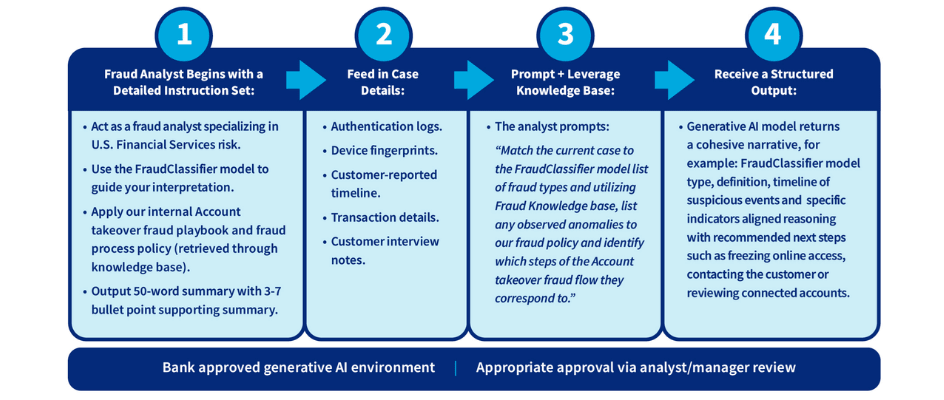
table describing four step process for large language model to review account takeover fraud

Use case 2: Reviewing a scam-driven authorized payment

Authorized payments resulting from scams are difficult fraud cases to manage because the customer initiates the transaction even though manipulation led to the decision. The ScamClassifier model helps identify the scam type and root cause, while the other data points provide additional context about related unauthorized activity.

Below are sample context instructions for a scenario from fraud case files where a consumer was deceived into sending funds under false pretenses.
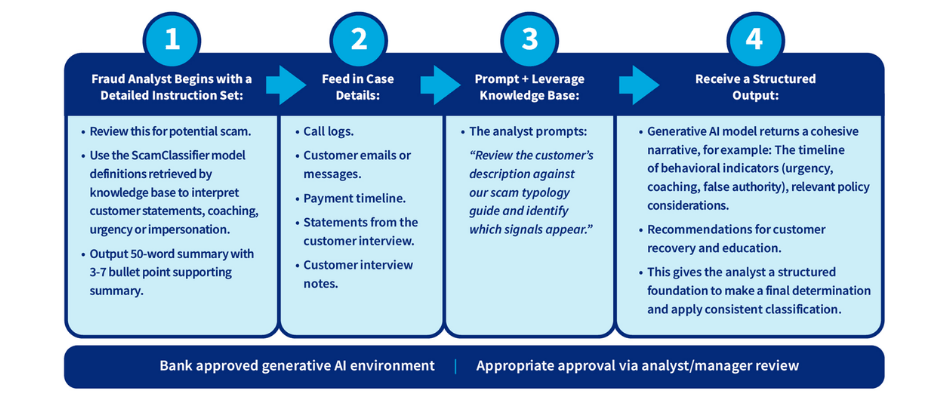
table describing four steps for large language model to review a scam-driven authorized payment

The human-AI partnership in fraud review

As powerful as generative AI has become, the analyst needs to remain at the center of every review and every resulting decision. The role of AI is to strengthen the analyst’s work, not replace their judgment. Generative AI can rapidly organize case information, reference internal policies through knowledge base surface indicators tied to the FraudClassifier and ScamClassifier models, and present consistent reasoning that reduces the risk of mistakes. But analysts bring context that AI cannot replicate: an understanding of customer behavior, nuances in communication styles, historical case patterns and the professional skepticism that only comes with experience. Generative AI accelerates work; the analyst points toward the right outcome. This collaboration creates a review process that may not only be more efficient, but also may be more consistent, defendable and aligned with industry-defined fraud structures.

Final thoughts

Fraud analysis has always demanded quick thinking, careful judgment and a structured understanding of how fraud and scam driven events unfold. The introduction of generative AI doesn’t change that requirement; it amplifies the analyst’s ability to meet it. When generative AI is guided by strong context instructions and grounded in internal policy knowledge bases and in the shared industry language provided by the FraudClassifier and ScamClassifier models, it becomes a reliable partner rather than a general-purpose tool. It helps analysts navigate complex and sometimes chaotic case information, highlights what matters most, and provides a consistent framework for classification and decision-making.

Generative AI is exciting and new, but outputs must be carefully tested and reviewed to ensure they meet expectations. Testing and human review will continue to be crucial. Analysts should not be discouraged by results that fall short. Instead, they should treat these moments as opportunities to refine how they are using the technology.

As fraud continues to evolve, the organizations that thrive may be those that combine the speed and structure of generative AI with the informed judgment of skilled analysts. Together, this partnership strengthens defenses, supports industry-aligned practices, and enhances the clarity and confidence of fraud reviews.


Related Content

  • Account Takeover Fraud Mitigation Toolkit (Off-site)
  • Scams Mitigation Toolkit (Off-site)
  • Fraud and Scam Classification Models (Off-site)

Current Issue

previous arrow
From awareness to action: Introducing our new Fraud Mitigation Resource Center

Fraud Mitigation

From awareness to action: Introducing our new Fraud Mitigation Resource Center
Q&A: Discussing the payments fraud landscape with Mike Timoney

Fraud Mitigation

Q&A: Discussing the payments fraud landscape with Mike Timoney
Beyond the fraud report: How the FraudClassifier℠ model can benefit your entire organization

Fraud Mitigation

Beyond the fraud report: How the FraudClassifier℠ model can benefit your entire organization
Surviving a scam: Managing the impacts and moving forward

Fraud Mitigation

Surviving a scam: Managing the impacts and moving forward
Combat fraud threats with FRFS tools powered by data and detection capabilities

Fraud Mitigation

Combat fraud threats with FRFS tools powered by data and detection capabilities
How KeyBank uses the ScamClassifierSM model to further scam awareness

Fraud Mitigation

How KeyBank uses the ScamClassifierSM model to further scam awareness
Guiding large language models (LLMs) toward better fraud, scam classification

Fraud Mitigation

Guiding large language models (LLMs) toward better fraud, scam classification
next arrow
  • X
  • LinkedIn

FINANCIAL SERVICES

  • Accounting
  • Check Services
  • FedACH Services
  • FedCash Services
  • FedNow Service
  • Fedwire Funds Service
  • Fedwire Securities Service
  • Multiservice Solutions
  • National Settlement Service

CENTRAL BANK

  • Lending Central (Discount Window)
  • Reporting Central
  • Reserves Central

TREASURY SERVICES

  • Collateral Services
  • Savings Bonds for Financial Institutions
  • Savings Bonds News You Can Use
  • Treasury ACH Reclamation
  • Treasury Auctions
  • Treasury Check Reclamation

FEDLINE® SOLUTIONS

  • FedLine Advantage
  • FedLine Command
  • FedLine Developer
  • FedLine Direct
  • FedLine Web
  • FedMail

FORMS

  • Accounting Services Forms
  • Central Bank Forms
  • Check Services Forms
  • FedACH Services Forms
  • FedCash Services Forms
  • FedLine Solutions Forms
  • Fedwire Funds Service Forms
  • Fedwire Securities Service Forms
  • National Settlement Service Forms
  • Treasury Services Forms

RESOURCES

  • Central Bank Resources
  • E-Payments Routing Directory
  • FedLine Solutions Resources
  • Financial Services Resources
  • Industry Links
  • Resource Centers
  • Rules and Regulations
  • Service and Access Setup
  • Service Fees
  • Treasury Services Resources

EDUCATION

  • Federal Reserve Bank Webinars
  • Industry Events
  • Products & Services Education

NEWS

  • Communications
  • Fed360
  • Press Releases
  • Research
  • Stay Engaged: Email Newsletters

ABOUT

  • About Federal Reserve Bank Services
  • Advisory Groups
  • Federal Reserve Bank Offices
  • Financial Services Leadership Team
  • Holiday Schedules

CONTACT

SITEMAP


This site is a product of the Federal Reserve Banks.
Terms of Use | Supported Browsers | Privacy Policy
General Reserve Bank Data Privacy Notice | Reprinting Articles

Address comments and questions to the
FRBservices.org Web Master
© 2026 Federal Reserve Banks