


If your institution is live on the FedNow® Service, you may be familiar with the FraudClassifier model (Off-site). FedNow participants are required to use codes corresponding to it when reporting fraud.
Aside from using the FraudClassifier model within the FedNow Service, financial institutions can also use it to classify fraud incidents across other payment types. The model can benefit your entire organization, as it helps:
- Establish a common language around fraud
- Provide a standardized framework for classifying and tracking fraud
- Develop clearer fraud insights and trend analysis
- Enhance employee training around fraud and speed up responses to fraud incidents
- Provide an executive-level view of fraud impacting your organization
- Streamline collaboration with other organizations in fraud mitigation and information sharing
Clearwater Credit Union, a values-based financial institution based in Montana, credits the FraudClassifier model as being essential to building and growing their fraud program. “When we implemented the model in 2020, it gave us immediate and actionable insight into the fraud trends we see at Clearwater,” says Brittany DeVries, senior vice president of payments at Clearwater Credit Union. “Its clear definitions and language help us track consistently, creating reliable data and reporting. This information allows us to effectively implement and adjust fraud strategies specific to our organization, to minimize losses for our members and the credit union.”
Speaking the same language about fraud
The FraudClassifier model, developed by a work group of fraud experts from the payments industry, asks questions that help its users understand how a specific fraud incident occurred.
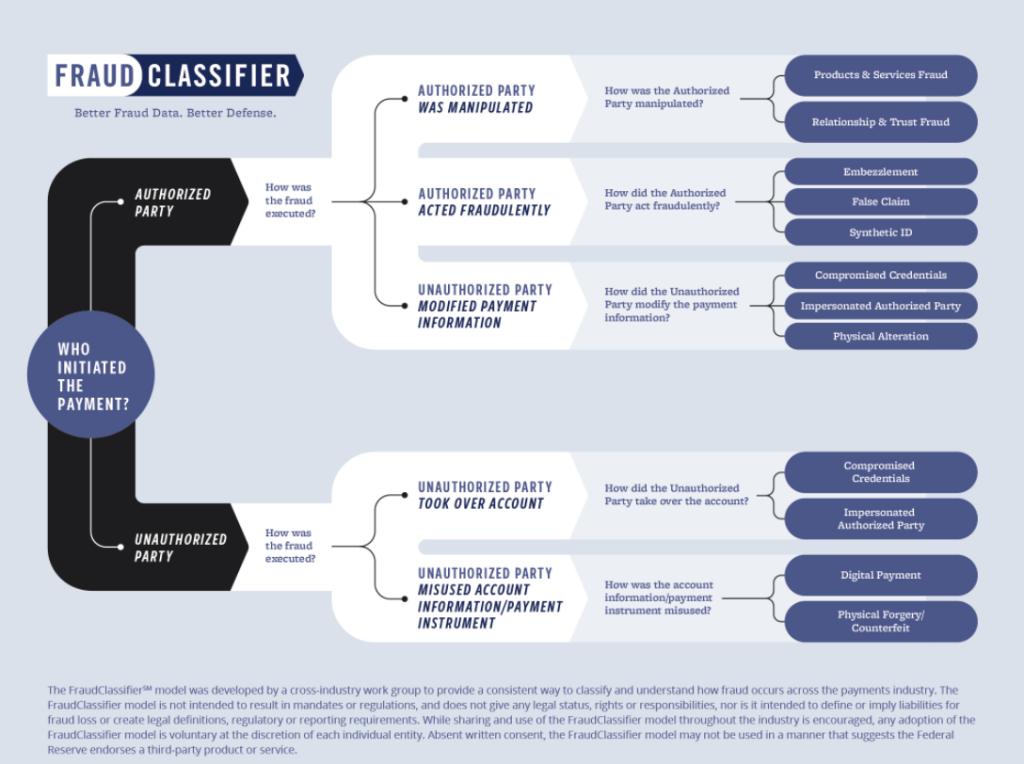
Let’s take the following example: Fred opens a deposit account under a fabricated identity that includes both stolen and false information. After a large deposit into that account, Fred initiates a wire transfer to an offshore account. He never transacts on the account again.
Before using the FraudClassifier model, different financial institutions — or even different teams within a financial institution — might have used a variety of names for this type of fraud. However, using the model, users answer three questions developed by fraud experts from the payments industry. For example:
- “Did an authorized or unauthorized party initiate the payment?” Authorized party.
- “How was the fraud executed?” The authorized party acted fraudulently.
- “How did the authorized party act fraudulently?” They used a synthetic identity.
Thanks to the FraudClassifier model, Fred’s financial institution can consistently classify the type of fraud that occurred in the example above as synthetic identity fraud (Off-site).
Improving staff training with the FraudClassifier model
While your organization can use the FraudClassifier model to help classify a single fraudulent event, it’s even more powerful when it informs your overall processes and plans.
For example, you could:
- Train your employees on the model so they can more easily identify different types of fraud
- Create a plan that tells your fraud response team what actions to take based on the type of fraud they identify
- Give your customer service team scripts with language for each type of fraud
There are lots of resources available from the Federal Reserve that build on the FraudClassifier model. The interactive version of the FraudClassifier model (Off-site) can be a great training tool for your staff. Plus, check out the resources and quizzes in the Fraud Mitigation Toolkits (Off-site) and join the FedPayments Improvement Community (Off-site) to stay up to date on the latest news and educational opportunities.
Raghu Sastry, vice president of technology at FinTech Automation LLC, explains that his organization appreciates how the model helps “our clients and our own operations and data science teams use the same terminology for fraud, which speeds up case review, reporting and root-cause analysis.”
Strengthening fraud reporting and analysis
In the synthetic identity example above, you might have noticed that the FraudClassifier model didn’t ask what type of payment the criminal used.
Instead, the model gives users a strategic, big-picture understanding of the type of fraud that occurred, which can help your organization:
- Track fraud trends across payment types
- Tailor customer education more effectively
- Create clear reports for leadership
- Feed clearer, more consistent data into anomaly detection models
FinTech Automation LLC has a real-life example of using the model for analysis and reporting. “Our machine-learning-based fraud monitoring product assigns each transaction a fraud probability score. We are integrating the FraudClassifier categories into the workflow so that analyst dispositions and confirmed cases are labeled consistently,” says Sastry. “Those labels will feed back into model monitoring and retraining, allowing us to track performance by fraud type and improve training data quality.”
Working together to help mitigate fraud
One of the most important tools that can help mitigate fraud in the payments industry is collaboration. The FraudClassifier model is seeing growing adoption (Off-site) among financial institutions, fintech companies and payment service providers.
If organizations increasingly refer to types of fraud with the same terms and analyze it similarly, it will be even easier for them to share information, understand trends and develop strategies to combat it — together.
Sastry notes that “standardized labels improve the quality of the data behind our models and make it easier to benchmark our fraud performance against industry data that uses the same framework.”
Using the FraudClassifier and ScamClassifier℠ models together
Organizations can use the FraudClassifier model on its own or with the ScamClassifier model (Off-site). Using the two models together (Off-site) can strengthen your organization’s risk mitigation efforts even further.
As of Oct. 1, FedNow Service participants’ fraud reports must include a scam type code corresponding to the ScamClassifier model, in addition to including fraud type codes from the FraudClassifier model. To learn more, watch the recording of the Sept. 23 FedNow User Group webinar about the ScamClassifier model.
Get started with the FraudClassifier model
To learn more about the FraudClassifier model and how to start using it at your organization, visit FedPaymentsImprovement.org (Off-site) and watch a recording (Off-site) of the Oct. 14 webinar, “Building Better Fraud Insights: The Power of a Shared Taxonomy.”