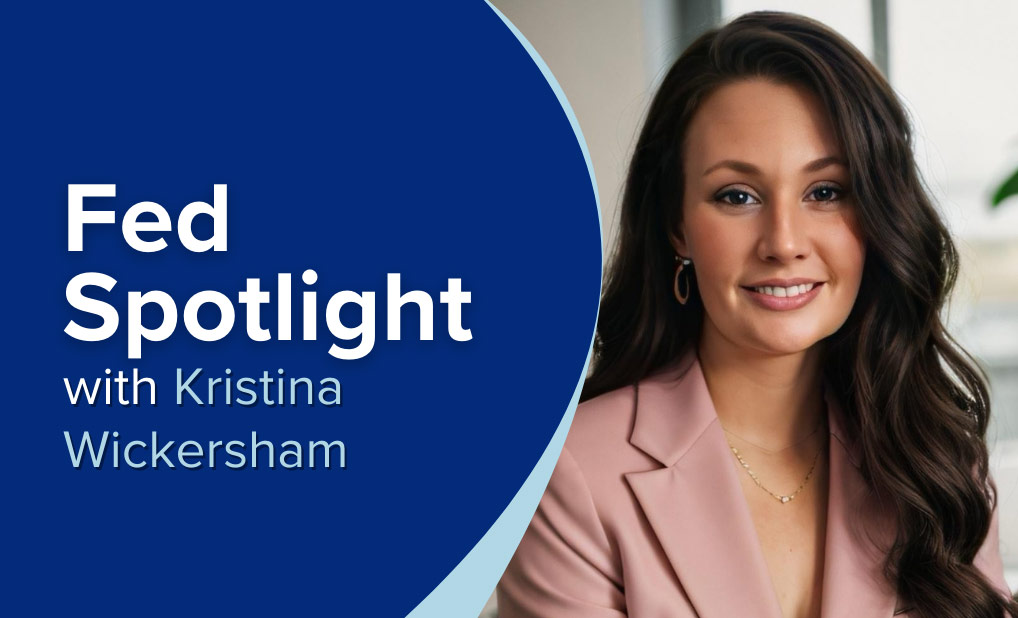

The Customer Relations team for Federal Reserve Financial Services (FRFS) is on the front lines of engaging with more than 9,000 financial institutions across the country. Meet Kristina Wickersham, one of this team’s many "faces of the Fed."
Q: When and why did you come to work for the Federal Reserve?
A: I’ve worked in banking my whole career, starting when my grandmother — as secretary to a community bank’s president — recommended hiring me part-time. My full-time career at financial institutions began in 2004 at a community bank, where I had several positions over the next 16 years at what grew into a midsize regional bank. These roles included teller, banker, lender on the retail side, and treasury management professional and implementation project manager on the commercial bank side.
In 2019, I advanced in the treasury management area by helping to meet the payment and money movement needs for a large bank’s top business clients in the government and insurance sectors. After the pandemic began, I learned more about payments innovation while working as an implementation project manager for a fintech company that built and customized bill payment solutions for some of the largest utility billers and financial institutions in the U.S.
In February 2022, I became a FedNow® Service onboarding manager in what became FRFS. I had always wanted to work for the Fed, especially after touring the Federal Reserve Bank of Chicago's Money Museum (Off-site) with local elementary school students. I admire the Fed’s mission, commitment to community service, and the diversity of areas it touches through its economists, auditors, other supervision and regulation staff, and financial services professionals. I became a FedNow Service client specialist in 2023.
Q: What did you do initially to facilitate FedNow Service onboarding?
A: Supporting a diverse portfolio of roughly 25 financial institutions with a mix of community banks, credit unions, large banks and service providers, my role was to educate them about how the FedNow Service’s payment flow works, benefits of instant payments and potential implementation strategies, including the connectivity options available to fit specific innovation enhancements This role helped me understand key decisions that financial institutions need to make as they start their instant payments journey.
First, financial institutions need to choose an initial implementation approach, which generally doesn’t require additions to staff. Then, they’ll need to decide how they will participate in the service and where they’ll settle transactions — in their own master account or that of a correspondent. It’s also reassuring for customers to understand the fraud risk management features (Off-site) offered by the FedNow Service. With the tools offered by the FedNow Service and the help of technology partners, financial institutions can implement functionalities that include transaction limits and other fraud mitigation features.
Once they’ve onboarded, financial institutions also must consider how to market their new product offerings to their customers, which has become easier as end users learn more about the benefits of instant payments (Off-site). The opportunities offered by instant payments are exciting.
Q: What do you do today as a FedNow Service client specialist?
A: In my day-to-day job, I interact with all types of financial institutions, from those with less than $500 million to institutions that have more than $3 trillion in assets, as well as individuals from the broader ecosystem, such as software companies and fintechs.
Customers and payments professionals talk to me as a FedNow Service subject matter expert at industry conferences, hear me on Fed webinars, or set up discussions through their assigned FRFS relationship manager. My top priority is to educate financial institutions on the ways the FedNow Service can help them gain new revenue; create operational efficiencies, such as non-batched and automated settlement; and meet their customers’ demand for instant payments.
The FedNow Service has outstanding name recognition — financial institutions and the consultants they hire increasingly request it by name. I also focus on sharing lessons current participants have learned. It’s critical for financial institutions to develop a strategic plan and put together a comprehensive internal implementation program. Additionally, we have encouraged some institutions to take a phased approach by implementing both receive and send during onboarding, even if they don’t plan on using send capabilities on day one. This can help streamline the FedNow Service onboarding process.
Q: What excites you about your current role?
A: Our customers are enthusiastic. Their questions have evolved from "What is an instant payment?" to more specific questions — not why they should implement instant payments but how best to do so. I’m excited about seeing how quickly customers are ramping up usage once they join the FedNow Service network. Many financial institutions start by enabling a specific vertical or line of business, then observing how, and how often, their customers use instant payments.
Instant payments are still relatively new, so naturally, financial institutions will need to work closely with their service providers to understand if or when they will support various use cases. For many, top-priority use cases include "me-to-me" transfers between an individual’s accounts at different institutions, vehicle loan funding in real time during a weekend, and other types of business-to-business payments. "Rising stars" among business use cases are real estate and insurance payments. Another great example is earned wage access, such as providing same-day payments for workers at the end of their shifts.
Q: What’s something your Fed colleagues may not know about you? Outside your Fed role, what do you do for fun?
A: Some of my colleagues may not know that I grew up in Mazon, pronounced muh-ZAHN, an Illinois farm town with a population of around 900 located two-and-a-half hours southwest of Chicago. My husband Alex and I still have friends there, although we now live about 21 miles northeast of Mazon in Channahon, Illinois. This area is known for its fossils. I’ve mostly found fossilized leaves in the Mazon Creek fossil deposit (Off-site). However, the most famous find was what became Illinois’ state fossil (Off-site), a soft-bodied, invertebrate marine animal nicknamed the "Tully monster."
Alex and I have three kids, aged nine to 20, and three dogs. They all keep me busy with activities and sports. I love to hike in the summertime with my family and dogs in places like Starved Rock State Park. I swim nearly every day at the YMCA because under the water is my peaceful place. Plus, I’m making it a habit to travel at least once a year with the family to new destinations. Rome is next on my list for international travel!
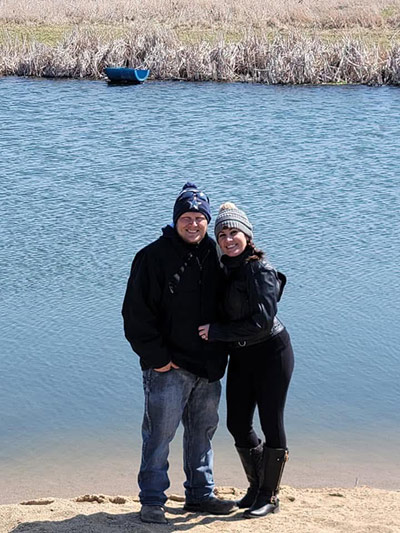
Alex and Kristina Wickersham on the banks of Mazon Creek