
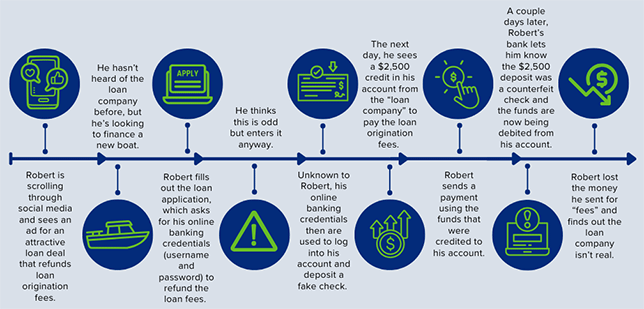
Individuals can be tricked into depositing fraudulent checks by being deceived or manipulated into providing their online banking credentials to a fraudster, which allows the criminal unauthorized access to their accounts through online or mobile banking. If customers are deceived into believing the deposit is from a legitimate source, they may spend the funds and find themselves with a financial loss when the deposited check is identified as fraudulent and removed from their account.
Discover how an unauthorized deposit fraud scheme (Off-site) can be detected as a check scam. The scheme demonstrates how an individual completes a loan application believed to be directed to a legitimate lender but that is actually triggered by a criminal impersonating a lender. The application prompts applicants for their online banking credentials, which they enter and therefore, unknowingly provide a criminal with access to their online banking accounts. As a result, a fraudulent deposit is made, and the “lender” tricks the applicant into sending them funds.
Prevent Unauthorized Deposit Fraud
Check deposit scams can lead to authorized transactions made by the authorized account owner, or unauthorized transactions, where a payment is initiated by a third party who has no legitimate right to move the money. The ScamClassifier model (Off-site) can be used along with the FraudClassifier model (Off-site) to classify an event when the root cause of unauthorized activity was a scam. Together, the models can be used to enable more robust classification for fraud reporting, prevention and education.
Expand Your Toolkit
Duplicate check deposit is another common method fraudsters use to perpetrate scams. FedDetect® Duplicate Notification for Check Services helps financial institutions fight this method of check fraud by providing early notice of potential duplicate U.S. government and non-U.S. government checks, including both personal and business checks. Notices are sent via encrypted email and may be used to supplement a financial institution’s research and help it take appropriate action.
The FedDetect Duplicate Notification for Check Services is available to Check participants at no additional cost and does not interrupt normal check processing. Contact the Support Center or reach out to your relationship manager to learn more.
Note: The ScamClassifier model is not intended to result in mandates or regulations, and does not give any legal status, rights or responsibilities, nor is it intended to define or imply liabilities for loss or create legal definitions, regulatory or reporting requirements. While sharing and use of the ScamClassifier model throughout the industry is encouraged, any adoption of the ScamClassifier model is voluntary at the discretion of each individual entity. Absent written consent, the ScamClassifier model may not be used in a manner that suggests the Federal Reserve endorses a third-party product or service.