How an established community bank is evolving with instant payments
5/1/2024
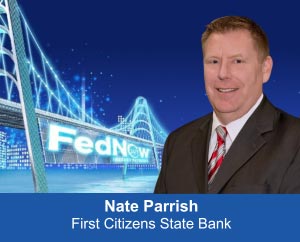
Nate Parrish is president of First Citizens State Bank (Off-site), a locally owned and operated community bank based out of Whitewater, Wisconsin.
We spoke with Parrish about learnings from the FedNow® Service onboarding journey, the use cases most relevant to First Citizens’ customers, and how the longstanding financial institution continues to modernize its payment offerings to best serve the community.
Q: Tell us about your customers and how they helped you identify a need for instant payments.
A: “First Citizens State Bank is a community bank with four branches across a relatively rural setting in Wisconsin. Our goal is to provide high-quality financial services to the communities we serve and to take on a leadership role in our community’s development. We saw instant payments as the future of payments early on, and we wanted to get in on the ground floor with the FedNow Service as another way we could serve our community. We accelerated our adoption because we knew that instant payments would take off, and we wanted to offer these payments to our customers as soon as possible.”
Q: Now that you’ve made instant payments available for your customers, what use cases are gaining traction at First Citizens State Bank?
A: “We are just getting started with instant payments but are excited to see how some early use cases grow such as earned wage access, particularly related to gig-economy employees. For our business customers, we see the request for payment (RFP) feature as a potential standout with benefits on both sides of business transactions: The customer can pay the RFP right away and get the bill off their desk, while the business receives the money right away and can allocate those funds as needed.
“Based on what we’ve seen so far, we are excited for what the future holds. It has been interesting to adopt the FedNow Service while also celebrating our bank’s 160th anniversary. Looking back at the transactions, things have changed so much — from hand-written ledgers to the FedNow Service — and it underscores the value of instant payments as a future-looking investment for us.”
Q: What are some advantages for consumers and businesses that bank at a community bank? Where does the FedNow Service fit into this strategy?
A: “One of the biggest benefits is that we know our customers and they know us. We see each other around the community, at the grocery store, at sporting events. We’re actively involved in the community, as well. When local deposits come into the bank, we try to utilize those in local loans that also support the community around us. And when our customers have questions or need to look to a financial institution for solutions, they know how to get ahold of somebody they trust.
“When we think of how we see the FedNow Service being utilized by our customers in the future, we want to prioritize those use cases that similarly benefit the community: rent payments, insurance payouts, bill pay. We want to be responsive to the use cases that will help our business customers better manage their cash flow, for example, or help our account holders avoid late fees with on-time payments.”
Q: How do you anticipate your instant payment offerings will evolve over time?
A: “Because we wanted to adopt quickly, we worked with our service provider to get set up as receive-only as a first step. We saw that as a ‘walk-before-you-run’ approach that would help us understand what our customers need and want with the FedNow Service. In the future, we’ll look to implement sending capabilities as well as integrating a customer-facing application to complement the online and mobile banking services we currently offer. The convenience of a fully integrated system is something we anticipate will be a big driver for future FedNow Service volume.”
Q: What advice would you give to other community banks looking to adopt the FedNow Service within the year?
A: “Work closely with your core provider and service provider to determine what’s best for your bank. It is important to have those conversations about capabilities, cost and timing. Look at your options, where your systems are currently and what services your bank can reasonably support. Because we’re a smaller bank, we have to be strategic when it comes to things like cost. But the service is flexible, and there are ways to prioritize what matters most so that your customers can still benefit from instant payments in a capacity that makes sense for your financial institution.”
Want to learn more about the real-world impact of instant payments? Read more FedNow Q&As here.