

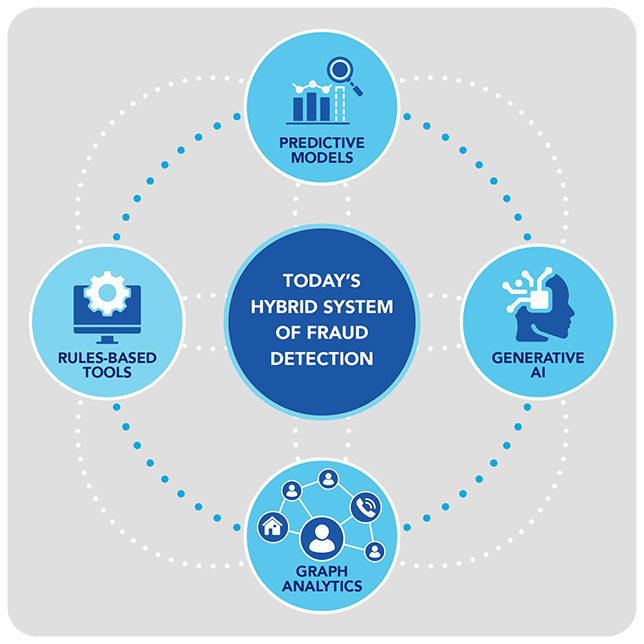
For years, fraud detection in financial services relied on static, rules-based systems that essentially functioned as digital checklists, flagging activity that didn't look "normal" or comply with predefined rules. As fraud became more sophisticated, the industry shifted to predictive models, which use large sets of historical data to anticipate which transactions might be risky or fraudulent. Graph analytics have added an even deeper layer by mapping relationships between people, accounts and behaviors to uncover patterns that individual transactions alone could never reveal.
Recently, with the wide availability of generative AI, both defenders and criminals are beginning to use these tools in new ways. These capabilities work alongside traditional rules-based tools, predictive models and graph analytics, forming a hybrid system that combines the strengths of each approach to better protect customers and organizations.
Attacks using generative AI
Fraud risks have accelerated in both scale and sophistication as generative AI becomes more widely accessible to criminals. One of the most immediate challenges is the mass production of content. Generative AI makes it easy to create highly convincing phishing emails, scam messages and social engineering scripts quickly and in multiple languages. This lowers the entry barrier for less skilled criminal actors by enabling them to launch attacks that previously required more technical expertise, coordination or language fluency.
Identity and access fraud may be evolving just as quickly. Generative AI technology can be used to generate synthetic identities (Off-site) that blend real and fabricated information in ways that are difficult to detect with traditional verification methods. It also enables the creation of forged documents and realistic deepfakes (video, voice or images) that can be used to bypass biometric checks (e.g., fingerprints, faces). These capabilities may compromise onboarding processes (Off-site), digital identity systems and physical authentication methods by overwhelming existing controls and enabling criminals to pass as trusted users during critical verification steps.
Business financial transactions also may become targets for generative AI-enabled manipulation. Attackers can generate fake invoices or fraudulent payment requests that mimic legitimate language and formatting. More advanced schemes can even simulate normal transaction behavior to slip undetected through risk scoring models, eroding the reliability of traditional anomaly detection methods and increasing the likelihood of unauthorized fund movement.
Fraud detection using generative AI
While generative AI is actively used by criminals, the same technology also is being deployed to mitigate fraud. Financial institutions have been experimenting with generative AI in a variety of areas, from improving customer service to streamlining operations. But fraud detection and prevention are top priorities, according to recent research. A 2025 KPMG study (PDF, Off-site) found that 76% of surveyed institutions view fraud-related use cases as their most valuable generative AI opportunity. The Federal Reserve Financial Services' 2026 Risk Officer Report (PDF) identified AI image analysis and machine learning as solutions for detecting anomalies and mitigating check and ACH fraud losses.
While traditional systems have focused on fixed rules or patterns derived from past behavior, generative AI introduces a different level of capability. It can interpret and synthesize massive volumes of data, including structured data (e.g., defined transactions or lists) and unstructured data (e.g., freeform text, audio recording or images) and other data types to help bring clarity to suspect transactions where other risk signals are scattered or unclear. This can make it especially valuable in situations where analysts must make rapid decisions despite incomplete information.
Rather than replacing earlier rules-based or predictive models, generative AI expands a financial institution's toolkit. It may capture nuance, highlight contextual meaning, and explain why certain activities may need further attention. Generative AI may help teams understand not just what looks suspicious but provide hypotheses of underlying reasons that make the behavior risky.
What’s next for financial institutions?
Given today’s challenging fraud landscape, financial institutions can benefit from exploring how generative AI can augment existing fraud detection tools and reduce investigation time.
This experimentation should be guided by a clear governance framework that addresses generative AI’s unique risks, including data privacy, model transparency and potential misuse. Teams across fraud, operations and customer-facing roles most likely will need training on how to effectively and responsibly use generative AI tools, as well as to understand their strengths and limitations. By investing in skills, layering defenses and building thoughtful governance, financial institutions can explore generative AI in a way that enhances fraud prevention without compromising trust or safety.